
The NTCP Diamond Framework
How Shenhar and Dvir’s model helps tailor project management to the challenge.
Waterfall, Agile, Kanban, Hybrid, Lean, Critical Chain, Scrum—the options are numerous. Yet organisations often choose a project management method before a project has begun or while it is still taking shape. Rather than simply following convention, first consider the project’s defining characteristics. The NTCP Diamond can help you make a more informed choice.
What is the NTCP Diamond?
The NTCP framework—developed by Aaron J. Shenhar and Dov Dvir—is a contingency model for projects. Its central idea is simple: one approach does not fit every project. Projects differ in uncertainty, scale and urgency, so their governance, planning, leadership and controls should differ as well.
NTCP stands for Novelty, Technology, Complexity and Pace. Each dimension is plotted on an axis radiating from a common centre. Connecting the four ratings produces a diamond-shaped profile: the farther a point lies from the centre, the greater the managerial challenge on that dimension.
The chart is neither a project score nor a maturity assessment. It serves as a diagnostic conversation: a visual description of the project context that helps leaders choose an appropriate management approach and identify gaps between the challenge and the organisation’s capabilities.
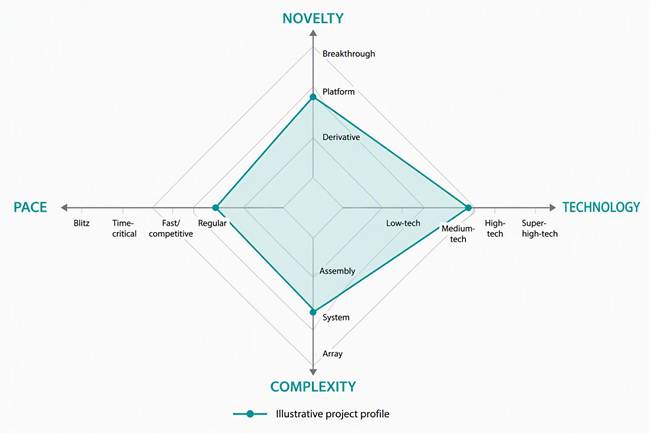
Figure 1. Illustrative NTCP profile. The connected ratings describe the project context; they are not a performance score.
The four dimensions
Novelty: How new is the offering to the market? Novelty describes how familiar customers and users are with the product, service or outcome. Typical levels are derivative (an extension of something familiar), platform (a new generation or family) and breakthrough (new to the market). Greater novelty usually means less reliable early market information, more discovery work and later stabilisation of requirements.
Technology: How uncertain is the technical solution? This axis ranges from low-tech, through medium-tech and high-tech, to super-high-tech. At the upper end, the required technology may not yet exist when the project begins. Increasing technological uncertainty calls for stronger technical expertise, experiments, prototypes, additional design cycles and a later design freeze.
Complexity: How broad and interconnected is the scope? Complexity is commonly classified as assembly, system or array. An assembly combines components into a single unit; a system integrates interdependent subsystems; an array coordinates multiple systems, often across organisations or locations. Greater complexity increases the need for systems engineering, interface management and formal coordination.
Pace: How urgent is delivery? Pace ranges from regular, through fast/competitive and time-critical, to blitz. A regular project has limited urgency; a time-critical project has a fixed window; a blitz project responds to a crisis. Higher pace demands faster decisions, empowered teams, protected priorities and explicit trade-offs.
Using the NTCP Diamond
Use the framework early—during portfolio selection, initiation or discovery—and revisit it whenever assumptions change. The aim is not perfect measurement, but a shared, evidence-based understanding of what makes the project difficult. In practice, this should be a coherent conversation rather than a rigid sequence of steps.
Begin with a clear project boundary. Clarify the intended outcome, strategic value, customer or user, major constraints and the decision the profile must inform. A diamond created without clear project boundaries can combine several initiatives and become misleading.
Then assess the four dimensions collaboratively. Bring together the sponsor, project manager, technical lead, commercial or user representative and key delivery partners. Select a level for each axis and document the evidence, assumptions and disagreements behind it. The discussion is often more valuable than the final shape.
Next, draw and interpret the profile. Plot the four levels and connect them. Focus on the axes that extend furthest from the centre, as these dimensions generally require the greatest adaptation. Also compare the project profile with the organisation’s experience and with similar past projects.
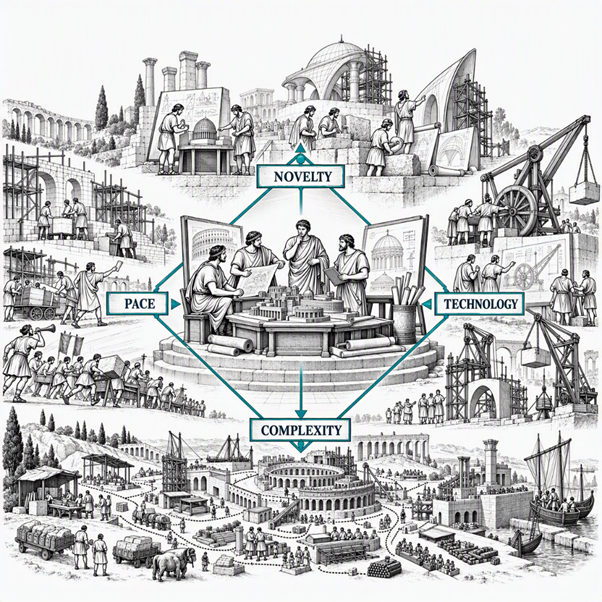
The highest ratings indicate where the management approach requires the greatest adaptation:
| Dimension | If the rating is high | Adapt the approach |
| Novelty | Needs and market response are uncertain | Use discovery, experiments, prototypes, staged commitments and frequent customer feedback. |
| Technology | The solution is uncertain or undeveloped | Fund technical exploration, recruit expert capability, allow iterations and maintain fallback options. |
| Complexity | Many subsystems and interfaces must align | Strengthen architecture, integration planning, interface ownership, configuration control and governance. |
| Pace | Delay has severe competitive or operational consequences | Shorten decision paths, dedicate resources, escalate quickly and define acceptable scope or quality trade-offs. |
Finally, test the fit with the organisation. Compare the required approach with current capabilities, culture, supplier network and governance. A large gap is a warning: change the project setup, acquire capability, reduce ambition, stage the work or reconsider the investment.
Revisit the profile at key decision points. The profile can shift. Customer learning may reduce novelty, technical experiments may lower uncertainty, and a regulatory deadline may increase pace. Re-profile at major decision points and adjust the management approach rather than treating the original chart as permanent.
Benefits of the framework
- Better fit. It replaces a standard methodology with choices tailored to the project’s actual uncertainty, scale and urgency.
- Earlier risk visibility. It reveals where assumptions, interfaces, technology or deadlines create exposure before detailed planning begins.
- Clearer executive dialogue. The visual profile gives sponsors and delivery teams a common language for discussing why one project needs different governance or resources from another.
- Smarter resource allocation. It supports decisions about leadership experience, specialist skills, contingency, prototyping and management attention.
- Stronger portfolio comparisons. Consistent profiles make it easier to compare projects, identify capability gaps and avoid concentrating too much risk in one part of the portfolio.
- Organisational learning. Comparing planned and actual profiles with project outcomes can build a reusable evidence base for future initiatives.
Limitations and good practice
The NTCP Diamond is a simplification, not a complete project method. Ratings can be subjective, dimensions can interact, and a single project may contain workstreams with very different profiles. Avoid false precision: document the reasoning and uncertainty behind every classification.
For large initiatives, create a portfolio-level diamond and separate profiles for critical workstreams. Combine NTCP with business-case analysis, stakeholder mapping, risk management, delivery metrics and domain-specific assurance. Most importantly, use the chart to trigger concrete decisions—not as a decorative workshop output.
Conclusion
The NTCP Diamond helps leaders ask a better question than “Which standard process should we follow?” Instead, it asks: “What kind of project is this, and what management approach fits it?” By making novelty, technological uncertainty, complexity and pace explicit, teams can align governance, capabilities, planning and controls with the real challenge—and adapt as that challenge evolves.
References
Aaron J. Shenhar and Dov Dvir, Reinventing Project Management: The Diamond Approach to Successful Growth and Innovation, Harvard Business School Press, 2007.
